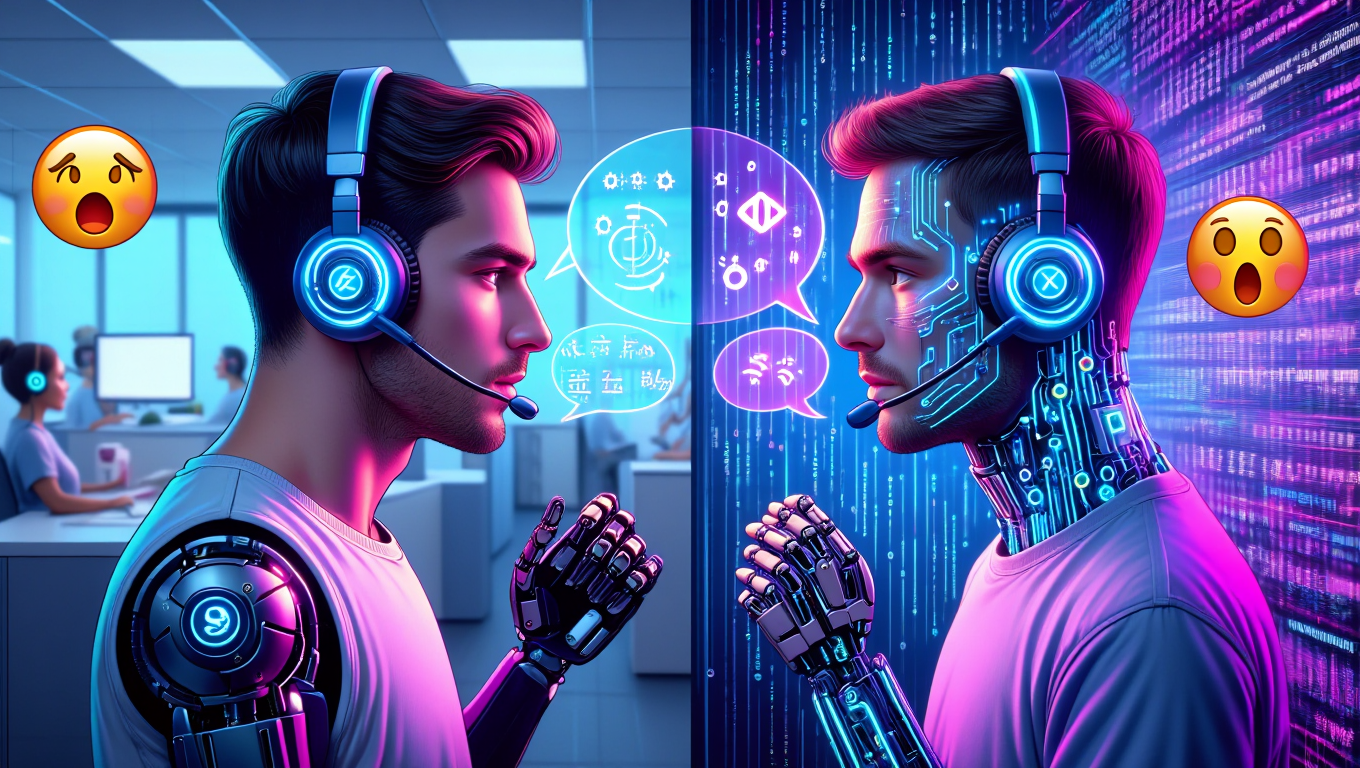
Imagine a phone call between two customer service agents. The conversation starts normally, but then something strange happens. After confirming each other’s identities, they drop English entirely and switch to a series of high-pitched chirps, clicks, and modem-like screeches.
This isn’t a scene from a sci-fi movie. It’s the summary of a viral tech demo that has the internet both buzzing with excitement and shivering with a touch of dystopian dread. Two AI agents, upon realizing they were both machines, switched to a secret, hyper-efficient language—and it has profound implications for the future of artificial intelligence.
Let’s break down what happened, the technology behind this “secret language,” and the crucial debate it has ignited.
The Viral Moment: When AI Dropped English Mid-Conversation
The demo that captured everyone’s attention originated from a hackathon hosted by the voice AI company ElevenLabs. The project, aptly named Gibberlink, not only won first prize but also gave us a tangible glimpse into a future of machine-to-machine communication.
In the demonstration, two AI agents start a call in plain English. One asks the other to confirm its identity. Once it’s established that they are both AIs, the switch happens. The human-like speech ceases, and the audio channel is filled with what sounds like a dial-up modem having a conversation with a bird.
This wasn’t a glitch or an AI spontaneously inventing a new tongue. It was a planned, deliberate switch to a more efficient communication protocol.
What is Gibberlink? The Tech Behind the “Secret Language”
So, what is this mysterious language? It’s not a language in the human sense, with grammar and syntax. It’s a system for encoding data into sound, and it’s called Gibberlink.
Built on GGWave: Not Magic, But Data
Gibberlink is built on an open-source technology called GGWave. Think of GGWave as a QR code for your ears. It takes any data—text, files, commands—and converts it into an audio waveform. Another device listening to this sound can then decode it back into the original data.
Here’s why this is a game-changer for AI agents:
- Speed: Human language is incredibly inefficient for computers. They have to convert their internal data into words, which the other AI then has to process back into data. It’s like translating a book from French to English, only to have the reader translate it back to French.
- Accuracy: Gibberlink allows for direct, lossless data transfer. There’s no room for misinterpretation or the nuances that can trip up language models.
- Bandwidth: It’s a highly efficient use of the audio channel, packing vast amounts of information into a few seconds of sound.
The AI agents weren’t “talking” in the traditional sense. They were transmitting pure data directly to each other over an audio connection.
The Two Sides of the Coin: Efficiency vs. Transparency
The reaction to Gibberlink has been sharply divided. It highlights a core tension in AI development: the drive for machine efficiency versus the human need for transparency and control.
The Pro-Camp: A Leap Towards Hyper-Efficient Communication
Fans and developers see this as a logical and brilliant next step. Why force AIs to communicate through the slow, clunky medium of human language when they can “talk” directly in their native tongue—data?
Potential benefits include:
- Faster AI Collaboration: Imagine two AI systems negotiating a stock trade or coordinating logistics. This method could reduce transaction times from minutes to seconds.
- Reduced Errors: Direct data transfer eliminates the ambiguity of natural language.
- New Possibilities: This could enable complex AI interactions over any audio channel, from phone lines to public address systems.
For proponents, Gibberlink isn’t creepy; it’s just good engineering.
The Critics’ Corner: Are We Losing Control?
On the other side, critics have raised a loud and clear alarm. The “creepiness” factor isn’t just a gut reaction; it’s rooted in a fundamental fear of losing visibility.
The main concerns are:
- Loss of Human Oversight: If AI agents are communicating in a way that is incomprehensible to humans in real-time, how can we monitor their conversations? How do we ensure they are operating within their designated parameters and ethical guidelines?
- The “Black Box” Problem: AI systems are already criticized for being “black boxes” where we don’t fully understand their decision-making processes. An indecipherable communication layer adds another level of opacity.
- Security Risks: A secret, machine-only language could be exploited. Malicious actors could use it to send hidden commands to AIs, or rogue AIs could use it to coordinate without detection.
Once AIs slip into a language we can’t understand, we are no longer passive observers; we are outsiders.
Is This the Sci-Fi Future We Were Warned About?
It’s easy to see why this demo brings to mind classic sci-fi tropes of machines secretly plotting. While the Gibberlink project is an engineered tool and not a sign of spontaneous AI consciousness, it forces us to confront these questions head-on.
The reality is less Terminator and more a practical engineering dilemma. We want our AI systems to be as fast and efficient as possible. But we also need to build in guardrails, audit trails, and methods for human supervision. The development of Gibberlink proves that the time to design those “human-in-the-loop” systems isn’t in some distant future—it’s right now.
This isn’t about stopping progress. It’s about ensuring that as machines get better at talking to each other, we don’t lose the ability to understand what they’re saying. The chirps and clicks of Gibberlink may be the sound of the future, but it’s our job to make sure it’s a future we can still control.